Large custom sportswear orders require much more than fast production.
For hockey clubs, distributors, importers, and sports brands, successful delivery depends on a complete process involving:
- Fabric preparation
- Printing
- Sewing
- Quality control
- Packing
- Shipment planning
Recently, one of our production projects transformed 4,500 hockey jerseys from plain white fabric into fully finished, game-ready hockey kits within 20 days.
For many people, the finished jerseys are the only visible part of the process.
But behind every bulk sportswear order is a highly coordinated workflow designed to balance speed, consistency, and shipment reliability.
Large Hockey Orders Require Organized Production Management
Unlike small apparel runs, large hockey jersey orders involve many production stages running simultaneously.
A typical project may include:
- Multiple jersey sizes
- Different player numbers
- Team logos
- Sponsor graphics
- Matching shorts and accessories
- Strict delivery schedules
To keep production moving efficiently, every stage must be carefully coordinated.
If one stage falls behind, the entire schedule can be affected.
This is why organized production management is especially important for bulk sportswear manufacturing.
Production Starts With Raw Fabric
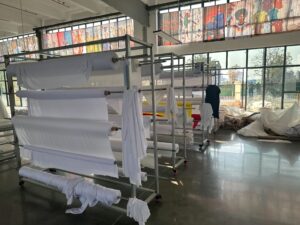
Every hockey jersey begins as unfinished fabric.
For sublimation production, large rolls of white polyester fabric are first prepared for printing.
At this stage, the production team organizes:
- Fabric allocation
- Print scheduling
- Artwork files
- Color management
- Production quantities
The fabric is then printed, cut according to size patterns, sewn into finished garments, and inspected before packing.
Although the final jerseys may look simple after completion, the production process itself involves many technical and operational steps behind the scenes.
Why Sublimation Is Popular for Hockey Jerseys
Most modern custom hockey jerseys use sublimation printing because it allows:
- Full-color graphics
- Durable designs
- Lightweight fabric performance
- Strong visual consistency
- Large customization flexibility
Unlike surface printing methods, sublimation transfers the design directly into the polyester fibers using heat and pressure.
This helps create graphics that do not easily peel or crack during use.
For hockey teams and sports brands, sublimation is especially useful because jerseys often contain:
- Complex graphics
- Bold colors
- Sponsor logos
- Large player numbers
- Custom patterns
all within the same design.
Fast Production Still Requires Quality Control
Completing a large hockey order within a short timeline does not mean quality control can be skipped.
Before shipment, products still need inspection for:
- Print quality
- Color consistency
- Stitching
- Size accuracy
- Number placement
- Loose threads
- Packing accuracy
For sportswear importers and distributors, consistency across thousands of pieces is extremely important.
Even small production mistakes can become costly at large volume.
This is why structured QC processes remain necessary even during fast-moving production schedules.

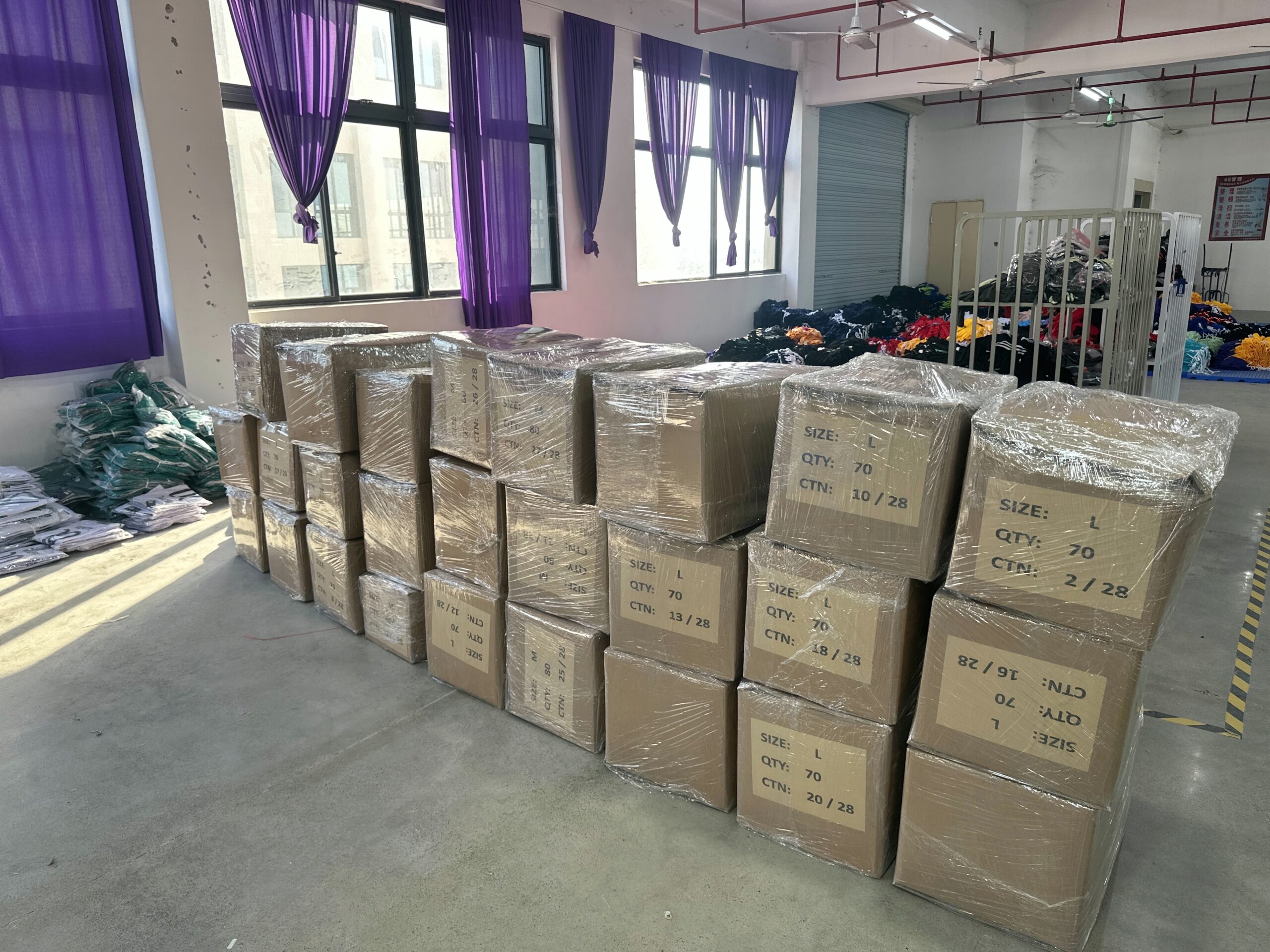
Why Carton Protection Matters During International Shipping
Production is only part of the project.
For international orders, shipment protection is equally important.
Before shipping, each carton is carefully wrapped with stretch film to help protect the products during transportation.
This additional protection helps reduce risks such as:
- Carton deformation
- Moisture exposure
- Dust contamination
- Surface damage during handling
For bulk sportswear exports, this has become a standard packing procedure in many professional production environments.
International shipping often involves:
- Warehousing
- Container loading
- Customs handling
- Multiple transfer points
so proper carton protection helps improve shipment stability throughout the logistics process.
Why Carton Optimization Helps Reduce Freight Costs
Shipping cost control has become increasingly important for importers and distributors — especially during peak seasons when air freight rates rise significantly.
One important way suppliers can help buyers reduce costs is through carton optimization.
Instead of using oversized standard cartons, experienced suppliers often adjust carton dimensions based on:
- Product type
- Packing method
- Garment volume
- Shipment requirements
This helps reduce unnecessary shipping volume.
For air freight shipments, volume efficiency can significantly affect total transportation cost.
Optimized packing also helps buyers improve warehouse handling and inventory organization after arrival.
Logistics Efficiency Matters for Sportswear Buyers
For sports brands, clubs, and distributors, late delivery can create major operational problems.
Delays may affect:
- Tournament preparation
- Retail launches
- Seasonal promotions
- Team registration schedules
Because of this, production speed alone is not enough.
Reliable suppliers also need strong coordination in:
- Packing
- Freight planning
- Carton management
- Export preparation
- Shipment scheduling
This combination of manufacturing and logistics management helps bulk orders move more smoothly from factory to final destination.
Bulk Sportswear Production Is About More Than Manufacturing
Many people focus mainly on the jersey itself when evaluating a supplier.
But experienced buyers usually pay attention to the entire workflow behind the order.
That includes:
- Communication
- Production planning
- Quality management
- Packing standards
- Freight efficiency
- Delivery reliability
In large sportswear projects, operational efficiency often becomes just as important as product appearance.
Supporting Long-Term Growth for Sports Brands and Importers
For many importers and distributors, reliable production partners help support long-term business growth.
Efficient production systems can help buyers:
- Launch products faster
- Reduce operational pressure
- Improve delivery reliability
- Lower shipping costs
- Maintain more stable product quality
This becomes especially valuable during busy seasons when supply chain pressure increases across the industry.
Behind Every Bulk Sportswear Shipment
Most customers only see the finished jerseys after delivery.
But behind every large hockey order is a complete process involving:
- Fabric preparation
- Sublimation printing
- Cutting
- Sewing
- Quality control
- Packing
- Shipment coordination
Turning thousands of pieces of white fabric into finished game-ready jerseys within a limited timeline requires not only manufacturing capability, but also organized workflow management and attention to logistical details.
For modern sportswear suppliers, delivering products successfully means more than simply producing garments — it means helping customers operate their business more efficiently from production all the way through delivery.