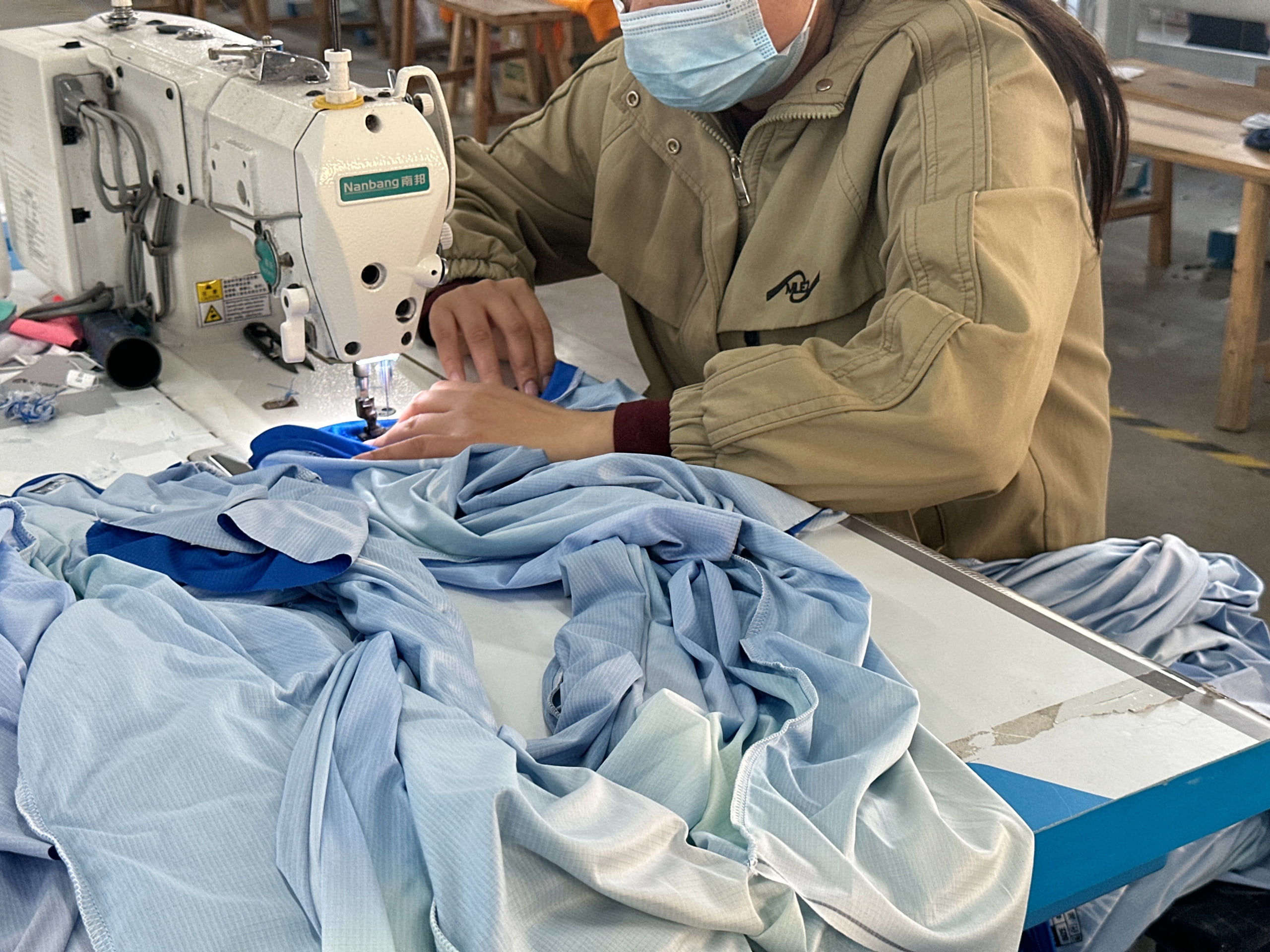
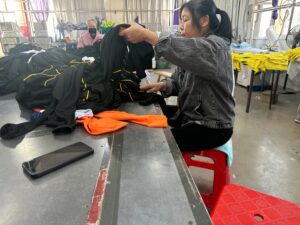
Many people imagine jersey production as a fully manual process.
Some buyers are surprised when they visit a sportswear factory for the first time and discover that large-scale fabric cutting is no longer done entirely by hand.
In fact, one question we occasionally hear from clients is:
“You produce thousands of jerseys every day — is all the fabric really cut manually?”
The short answer is no.
And for modern sportswear manufacturing, there are good reasons why automated cutting systems have become an important part of production.

Why Manual Fabric Cutting Has Limitations
Years ago, manual cutting was much more common in apparel manufacturing.
Skilled workers would spread fabric layers on long cutting tables and cut garment panels by hand using electric cutting machines.
While manual cutting is still used in certain situations today, relying entirely on manual methods becomes increasingly difficult when production volume grows.
For teamwear factories handling large orders, manual cutting usually creates three major challenges.
1. Higher Labor Costs
Large-scale jersey production involves thousands of fabric panels every day.
Each football jersey includes multiple components such as:
- Front panels
- Back panels
- Sleeves
- Collars
- Shorts panels
Cutting these pieces manually requires a large amount of labor.
As production volume increases, labor costs also rise significantly.
Automated cutting systems help reduce repetitive manual work while improving overall production efficiency.
2. Production Bottlenecks
Manual cutting speed depends heavily on worker experience and physical workload.
During peak production seasons, this can easily become a bottleneck for factories managing large football kit orders.
If cutting slows down, the entire production process may also slow down, including:
- Printing
- Sewing
- Quality control
- Packing
- Shipment scheduling
Automated systems help maintain more stable cutting speed across large production batches.
This improves workflow coordination throughout the factory.
3. Inconsistent Cutting Accuracy
Precision matters in sportswear manufacturing.
Even small cutting differences can affect:
- Garment sizing
- Sewing alignment
- Logo placement
- Overall fit consistency
With manual cutting, accuracy can vary depending on:
- Worker skill level
- Fatigue
- Fabric movement
- Cutting pressure
Automated cutting systems help improve consistency by following digital cutting patterns with high precision.
For larger teamwear orders, this consistency becomes especially important.
How Automated Fabric Cutting Works
Modern automated cutting systems combine software control with high-speed cutting equipment.
The process usually starts with digital pattern files prepared by the pattern-making team.
After the fabric is spread and layered, operators input the cutting data into the machine.
The system then automatically cuts the fabric panels according to the digital patterns.
This process allows factories to achieve:
- Faster cutting speed
- Higher cutting precision
- Better size consistency
- More stable production output
Because the system follows digital commands, it can also help reduce human error during repetitive production work.
Why Digital Pattern Accuracy Matters
Automated cutting systems are only as accurate as the patterns prepared beforehand.
This is why professional pattern-making remains extremely important in sportswear manufacturing.
Pattern development affects:
- Jersey fit
- Sleeve shape
- Collar balance
- Movement comfort
- Size grading
Once accurate digital patterns are created, automated cutting systems can reproduce them consistently across large production volumes.
For football clubs, academies, and sports brands, this helps improve sizing consistency between different production batches.
Why Automation Is Especially Useful for Teamwear Production
Custom sportswear production often involves large quantity orders with multiple sizes.
A single academy order may include:
- Youth teams
- Adult teams
- Coaches
- Goalkeepers
- Training products
- Multiple jersey styles
Managing these variations manually becomes increasingly difficult at scale.
Automated systems help factories organize and process complex orders more efficiently while reducing the risk of cutting mistakes.
This is one reason why automation has become more common in modern teamwear production environments.
Automation Does Not Replace Quality Control
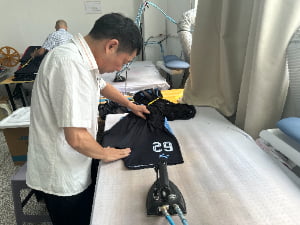
Although cutting systems are automated, human supervision remains extremely important.
Production teams still need to monitor:
- Fabric quality
- Pattern accuracy
- Layer alignment
- Cutting quality
- Material defects
Automation improves efficiency, but experienced workers and QC staff are still necessary to maintain stable production standards.
Modern manufacturing is usually a combination of:
- Skilled workers
- Digital systems
- Process management
- Quality control procedures
rather than fully replacing human involvement.
Why Production Efficiency Matters for Importers and Brands
For importers, distributors, academies, and sports brands, production efficiency directly affects delivery reliability.
Stable production systems can help reduce:
- Delays during peak seasons
- Rework caused by cutting errors
- Size inconsistency problems
- Production bottlenecks
This becomes especially important for buyers handling:
- Seasonal launches
- Tournament deadlines
- Retail schedules
- Multi-team programs
Reliable production processes often matter just as much as product appearance.
Technology Is Changing Sportswear Manufacturing
Over the past decade, sportswear manufacturing has evolved significantly.
Factories increasingly use technology in areas such as:
- Sublimation printing
- Digital pattern making
- Automated cutting
- Production management
- Quality tracking
These systems help improve:
- Efficiency
- Consistency
- Production speed
- Scalability
For modern teamwear suppliers, technology is no longer simply an upgrade — it has become an important part of maintaining competitive production standards.
Behind Every Jersey Is a Production System
Most players only see the finished jersey.
But behind every football kit is a complete production workflow involving:
- Pattern development
- Fabric preparation
- Printing
- Cutting
- Sewing
- Inspection
- Packing
Automated cutting systems are one part of that process, helping manufacturers improve efficiency and consistency while managing large production volumes more effectively.
For clubs, academies, importers, and sports brands, understanding these production systems can also provide a clearer picture of what influences product quality, lead time, and manufacturing reliability.